
Best Video Analytics for Manufacturing Plants Compared by Use Case
Jeff Zeller | September 17th, 2026
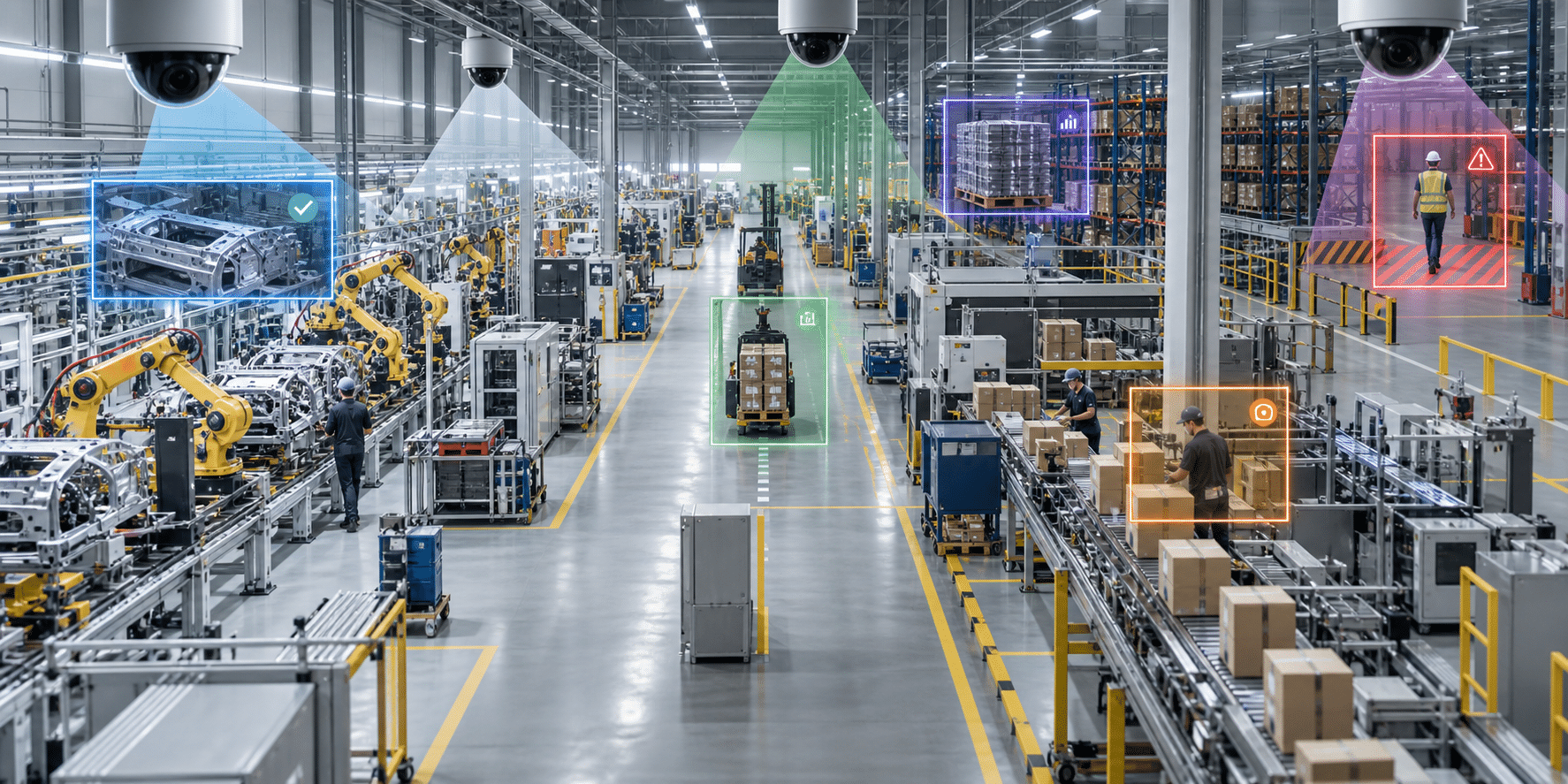
A camera on a plant floor only becomes valuable at the moment its footage turns into a decision someone can act on. Recording is cheap and has been for years, which is why most facilities already have more video than they can realistically watch. What separates one video analytics platform from another is not the presence of artificial intelligence in the marketing material, but the specific question the system was built to answer: whether a guard was in place, whether a weld looked right, whether a station ran long, or whether an aisle was blocked.
That is why comparing these platforms by use case is more useful than ranking them on a single scale. A tool designed to study human motion on a manual assembly line will not behave like a platform designed to embed analytics in millions of surveillance cameras, and neither will behave like a system built for inline visual inspection. The sections below walk through the major use cases, the architectural questions underneath them, and how to match a platform category to what your plant actually needs.
What Video Analytics Actually Does on a Plant Floor
Video analytics sits on top of a camera feed and converts pixels into structured events: an object detected, a state classified, a threshold crossed, a duration measured. That shift matters because passive recording puts the entire analytical burden on a person with limited hours. As the review 5 Best Manufacturing Video Analysis Software Tools (2026 Review) puts it, Legacy cameras (CCTV) are useless for process improvement because no one has time to scrub through 8 hours of footage to find a 2-minute stop. Analytics changes the economics by surfacing the two minutes instead of storing the eight hours.
The vendor landscape splits along the lineage of each platform rather than along feature checklists. Some tools grew out of industrial engineering practice, and the same review describes Drishti as the world leader in analyzing human motion on manual assembly lines. Others grew out of security and surveillance, such as Irisity AB, whose IRIS+ platform is described in 11 Best AI Video Analytics Companies in 2026 for Smart Surveillance as built on twenty years of experience and running on a highly scalable IoT architecture. A third group sells analytics as an embedded component, and that same review notes Intellivision’s products are used in over seven million cameras globally, aimed primarily at original equipment manufacturers and large integrators. Understanding which lineage a platform comes from usually predicts how it will behave inside your plant.
Safety and Compliance Monitoring
Safety monitoring is often the first use case a plant funds, because the cost of an incident is immediate and the visual signals are relatively legible to a model. Typical detections include personal protective equipment on a person entering a zone, workers crossing into restricted areas around moving equipment, blocked egress routes, spills, and the presence of a spotter during lift operations. Matroid says users can detect and classify defects, objects, assemblies, hazards, and events, which is the category of work this use case depends on, since a hazard is usually a combination of an object and a context rather than an object alone.
The stakes in adjacent industrial environments help explain the urgency. Video Analytics Software at Manufacturing Plants cites a report finding that with 9.7 fatalities per 100,000 workers, construction continues to have the fourth-highest rate of job site fatalities of any industry. Manufacturing environments share many of the same physical risks, including heavy machinery, elevated work, and shared pedestrian and vehicle traffic.
Two cautions belong in any evaluation. A detection system supports safety and compliance teams with faster visibility, but it does not replace the judgment of the people responsible for those programs, and alerts should route into an existing review process rather than around it. Monitoring people also raises legitimate questions about consent, retention, and scope, so it is worth deciding early which detections serve safety and which drift into surveillance your workforce did not agree to.
Quality Control and Defect Detection
Quality use cases are where video analytics most directly touches product cost, because a defect caught at the station where it was created is far cheaper to resolve than one caught at final inspection or at a customer. The detections here tend to be narrow and specific: surface damage, edge chipping, contamination, misaligned components, missing fasteners, incorrect labels, or the presence and absence of parts in an assembly. Matroid says users can detect and classify defects, objects, assemblies, hazards, and events, and in a quality context that combination matters, since confirming an assembly is complete is a different problem from confirming a surface is unmarked.
When you compare platforms for quality work, the useful questions are about specificity and iteration rather than headline capability. Ask how many distinct defect classes the system can hold without collapsing them into a single reject signal, how quickly a new class can be added when a new failure mode appears, and how borderline cases are reviewed by a person before they become a scrap decision. No vendor should promise perfect detection, and you should plan for both false positives that waste operator attention and false negatives that let a defect continue downstream.
The longer-term payoff is analytical. Once defect events are timestamped and tied to a line, shift, tool, or station, you can start seeing which conditions correlate with which failures, which is the kind of insight that manual inspection sheets rarely produce at usable resolution.
Worker and Workflow Analytics
Workflow analytics answers a different question than quality or safety: not what went wrong with the product, but where the process loses time. The traditional method is the time and motion study, and 5 Best Manufacturing Video Analysis Software Tools (2026 Review) describes Drishti as using AI to digitize that older methodology, with a focus on analyzing human motion on manual assembly lines. In practice that means cycle times per station, variation between operators, sequence deviations from a documented standard, and the micro stoppages that never make it into a downtime log because nobody had time to record them.
This is also the use case where the value of analytics over raw footage is most obvious, since the exact events you want to study are short, scattered, and invisible in aggregate. SOP conformance checks fit naturally here, because a workflow model that already understands station sequence can flag a skipped step or an out-of-order operation.
Because these systems observe people rather than parts, scope discipline matters. The strongest implementations are framed around process improvement, use aggregated patterns rather than individual scorecards, and are explained to the workforce before cameras start feeding models.
Deployment Architecture and Camera Compatibility
Architecture decides how far a pilot can travel, and it is the criterion most often underweighted during evaluation. Hardware-bundled platforms simplify procurement but constrain what you can change later, and 11 Best AI Video Analytics Companies in 2026 for Smart Surveillance lists among Verkada’s drawbacks an Architecture built on proprietary cameras with fixed processing capabilities, alongside a ten-year hardware warranty and a cost the review calls high relative to other options. Embedded analytics sit at the other extreme, with Intellivision’s suite designed primarily for OEMs and large integrators rather than for a quality engineer configuring a new inspection. Surveillance-native platforms such as IRIS+ are described as running on a highly scalable IoT architecture, which suits distributed camera estates but reflects security priorities in how it models events.
For a plant with mixed camera vintages, a camera-agnostic approach usually costs less to expand, because each new use case does not require a new hardware cycle. Matroid says its software works with any image or video hardware, which means existing feeds, machine vision cameras, and newly installed views can all become inputs to the same detectors. Beyond compatibility, confirm where inference runs, how the system behaves when network connectivity drops, and how much bandwidth continuous streaming will add to a network that already carries production traffic.
Model Drift, Alert Fatigue, and Long-Term Accuracy
A model that performs well in a pilot is describing the conditions of that pilot, including its lighting, product mix, fixture positions, and camera angles. Plants change all of those things routinely, so accuracy erodes unless someone owns retraining as an ongoing responsibility rather than a launch task. This is why the operational tooling around a model deserves as much scrutiny as the detection itself. Matroid says its platform includes custom detector studio, MLOps architecture, quick training, and analytics from video streams, and that combination points at the practical need to retrain, version, and monitor detectors after deployment. No-code creation lowers the barrier to building a detector, but it does not remove the need for technical ownership, labeled examples, and periodic validation against known conditions.
Alert fatigue is the second slow failure. A detector tuned too sensitively floods a shift lead with notifications that get dismissed, and once dismissal becomes habit the system stops functioning even though it is technically working. Sustainable deployments define who receives each alert class, what response each one requires, and what threshold or confidence level triggers escalation rather than logging. Reviewing dismissal rates and false positive rates by detector, month over month, tends to reveal problems long before anyone declares the project failed.
Matching Platform Type to Plant Requirements
Once you accept that these platforms come from different lineages, selection becomes a matter of matching category to the problem you are actually funding. A useful shortcut is to name the primary question first, then evaluate only the platforms designed to answer it, since a tool stretched outside its origin usually delivers a shallow version of what a purpose-built system does well.
- Human motion and cycle time on manual lines: motion study specialists such as Drishti, described as the world leader in that category.
- Perimeter, intrusion, and large distributed camera estates: surveillance-native platforms such as IRIS+ from Irisity AB.
- Analytics embedded in hardware you resell or integrate: OEM-oriented suites such as Intellivision.
- Inline defect detection, assembly verification, hazard and event detection across existing cameras: enterprise computer vision platforms with camera-agnostic deployment.
Most plants discover that their requirement is not singular. Quality wants defect classes, safety wants zone and PPE detections, and operations wants cycle time visibility, and each group already has cameras pointed at something relevant. In that situation the deciding factor is whether one platform can hold multiple detector types across heterogeneous hardware, because running three narrow tools multiplies integration work, training data ownership, and alert routing complexity.
This is the gap Matroid is built for, as an enterprise no-code computer vision platform for teams that need visual inspection and video analytics without a bespoke engineering project for every new question. Matroid says its software works with any image or video hardware, and that users can detect and classify defects, objects, assemblies, hazards, and events, which spans the quality, safety, and operational monitoring cases that usually arrive separately and then converge. Matroid says its platform includes custom detector studio, MLOps architecture, quick training, and analytics from video streams, which addresses the durability problem of keeping detectors accurate as lines, products, and conditions change. The approach is most useful where manual visual review is slow, expensive, or inconsistent, which describes a large share of the inspection and monitoring work still done by eye today.
Whatever category you shortlist, structure the evaluation around a real line, a real defect or event class, and a real camera you already own. Ask each vendor to show detection on your footage rather than a reference dataset, ask who maintains the model in month twelve, and ask what happens to accuracy when the product changes. If you want to see how a camera-agnostic, no-code approach handles your specific inspection or monitoring case, get a demo and test it against the conditions your plant runs every day.
TL;DR: Rather than ranking video analytics platforms on a single scale, this guide matches each major platform category to a specific manufacturing use case, covering assembly motion study, inline visual inspection, and safety monitoring so plant operators can choose based on the question their facility actually needs to answer.
Building Custom Computer Vision Models with Matroid
Dive into the world of personalized computer vision models with Matroid's comprehensive guide – click to download today