
What Compliance Tools Do on the Plant Floor When Monitoring Is Continuous
Jeff Zeller | September 14th, 2026
A compliance program is only as strong as the last hour of production it can honestly account for. Documentation proves that a plant knew what it was supposed to do, while continuous monitoring is what shows the work was actually done that way, on that shift, at that station, with the materials and settings the procedure called for. When verification happens only at intervals, a plant tends to learn about drift after it has already built parts, and the correction turns into a containment exercise instead of a small line-side adjustment.
The most useful way to evaluate compliance software, then, is to ask what it does while the line is moving rather than what it stores after the run is closed. Continuous monitoring changes the job description of a compliance tool from record keeper to participant, because the software is now watching conditions, gating steps, raising deviations, holding product, and writing evidence in the same minutes that value is being added to a part.
The Gap Between a Stored Policy and a Completed Task
Nearly every manufacturer with a regulated product already owns a complete library of procedures, and most of that library is in reasonable shape: versioned, approved, mapped to a standard, and retrievable within seconds of an auditor asking. What the library cannot tell you is whether third shift ran the cleaning sequence in the prescribed order, whether the wrench used at station four was the calibrated one, or whether the operator who signed the record was watching each step or reconstructing the sequence from memory once the run finished. Document systems capture attestation, and attestation is a statement about work rather than a measurement of the work itself.
That distinction is the entire reason continuous monitoring earns a place on the plant floor. The roundup 7 Best Manufacturing Compliance Software Tools puts the requirement about as plainly as it can be put: You need software that ensures the maintenance task was actually done according to the standard. The same test applies to changeovers, in-process checks, line clearance, sanitation cycles, and every other activity where the record and the reality can quietly diverge.
Divergence is rarely the product of bad intent, which is why paperwork alone never closes the gap. Signatures get batched at the end of a shift because the schedule was tight, two experienced operators interpret an ambiguous instruction in two defensible ways, a step gets performed out of order because the fixture was still occupied, and a check gets marked complete because it always passes. None of those moments feels like a violation while it is happening, and none of them leaves a trace in a document control system.
The cost shows up later, when something is wrong and nobody can bound the problem. If the only evidence of execution is a signature covering an eight-hour window, then the containment scope becomes that entire window, along with everything downstream of it. Execution-level records shrink that scope from a shift to a station and a timestamp, which is usually the difference between scrapping a pallet and scrapping a production day.
Real-Time Shop Floor Monitoring and What It Actually Captures
Continuous monitoring on a plant floor is not a single feed but a set of parallel observations, each answering a different compliance question about the same moment in production. Understanding what those observations are, and which ones your current systems already collect, is the fastest way to find the blind spots where deviations survive unnoticed.
- Machine and process state read from controllers, including speeds, temperatures, pressures, dwell times, and the active recipe or program identifier
- Part and assembly presence, orientation, and count at each station in the sequence
- Operator actions and their order, including tool pickup, fastening confirmation, scan events, and step completion signals
- Material and label identity at the point of use, linking lot and batch numbers to the specific unit being built
- Area conditions such as guard position, occupancy of a hazard zone, housekeeping state, and required protective equipment
- Timing and cadence, including cycle time, idle gaps, and how long a station sat in an abnormal state before someone intervened
Those observations fall into two families that behave very differently in practice. The first family is what equipment reports about itself, which is generally reliable, easy to timestamp, and already flowing into historians and process control systems in most modern plants. The second family is what the physical world shows: whether the correct component went into the correct slot, whether a pallet of released material was staged next to a pallet of rejected material, whether an interlock was defeated with a piece of tape. Historically that second family required a person to walk over and look, which meant it was sampled rather than monitored.
Cadence matters as much as coverage, because the interval between checks defines the maximum amount of nonconforming production a plant can create before it knows anything is wrong. A quality check performed once per hour accepts an hour of exposure by design, and that arithmetic does not change no matter how rigorous the check itself happens to be. Continuous observation compresses that exposure toward a single cycle, and it also produces something a sampled check never can, which is a full population record instead of a statistical inference about the units nobody looked at.
Enforcing Work Instructions at the Workstation Level
Work instructions become enforceable only when the system that displays them is also the system that verifies them. In a gated workflow the station presents one step at a time, waits for evidence that the step was completed as specified, and refuses to advance until that evidence arrives or a supervisor records an authorized exception. The instruction stops being a reference document on a laminated sheet and starts behaving like a condition of production.
What counts as evidence depends on the step, and the practical work of implementation is choosing a verification method proportionate to the risk involved. A scan of a component barcode confirms that the right part number reached the right station. A signal from a connected torque tool confirms that a fastener reached the specified value in the specified sequence rather than being finished by hand. A weight check confirms that a fill fell inside tolerance. A visual check confirms presence, absence, orientation, seating, and labeling on the assembly in front of the operator, which is exactly the category of check that resisted automation the longest.
Enforcement design deserves as much attention as enforcement capability, because a workflow that blocks production for trivial reasons trains people to route around it. Hard stops belong on steps where a missed action creates a safety hazard, a regulatory violation, or a defect that becomes invisible after the next operation closes the assembly. Softer prompts, confirmations, and post-hoc flags fit steps where the consequence of an error is recoverable and the cost of stopping the line is high. Every override needs to be available to a qualified person, recorded with a reason code, and reviewed on a cadence, because an override pattern is often the earliest signal that an instruction no longer matches the physical reality of the station.
Done well, station-level enforcement also carries an underrated training benefit for plants that run high turnover or heavy seasonal staffing. A new operator working inside a gated sequence receives correction within seconds instead of learning a bad habit that a lead has to unwind three weeks later, and the plant gains a record of where new hires actually struggle rather than where the training matrix assumes they will.
What Happens at the Moment a Deviation Is Detected
Detection is only the opening move, and the value of continuous monitoring lives almost entirely in what the system does in the seconds and minutes that follow. A tool that detects a deviation and does nothing but log it has reproduced the old problem in a faster format, because the plant still finds out during a review meeting rather than while the condition is correctable.
- Classify the event against a severity model so that a cosmetic anomaly and a safety-critical failure do not generate the same response
- Notify the specific people responsible for that station, line, or area through the channel they actually monitor during a shift
- Contain the affected material by flagging units, applying a hold, or diverting product away from the next operation
- Gate further production where the risk warrants it, including stopping a station or requiring a supervisor release before restart
- Record the event with its timestamp, station, product identifier, supporting evidence, and the identity of whoever dispositioned it
Containment scope is the part most teams underestimate until they need it. When a deviation surfaces, the immediate question is never only what happened but how far back the condition may have existed, and the answer depends on when the last verified good state was established. Continuous records let a plant walk backward through individual cycles and bound the affected population precisely, while interval records force a conservative assumption that sweeps in everything since the previous check. The same records support the forward question of where the affected units went, which is what turns a theoretical traceability process into a practical one.
Detection also feeds the corrective action process with something better than recollection. A nonconformance opened from a monitored event arrives with the conditions attached: the recipe in use, the operator sequence, the machine parameters, the material lots, and often visual evidence of the condition itself. Root cause analysis conducted against that kind of record spends its time on causation rather than on reconstructing what happened, and repeat-cause patterns become visible across shifts, lines, and sites.
None of this removes human judgment from the loop, and no serious compliance architecture should pretend otherwise. Software identifies conditions and enforces the rules it has been given, while decisions about product disposition, worker safety, regulatory notification, and release remain with qualified people who carry that accountability. The realistic goal is to give those people earlier, better grounded information and a defensible record of the basis for each decision.
Line Clearance, Shift Handoff, and Maintenance Holds
Some of the highest-risk minutes in a plant occur when nothing is being produced. Changeovers, cleanouts, handoffs, and maintenance interventions all involve a physical state that must be confirmed before production resumes, and they are exactly the activities where a checklist signature is easiest to earn without a thorough walk.
Line clearance is the clearest example, because the entire point is verifying absence. Before a new product, lot, or formulation starts, someone must confirm that no components, labels, cartons, or residues from the previous run remain anywhere on the line, that the correct materials are staged, and that the equipment is set to the new configuration. Continuous monitoring supports that verification by observing the physical state of the line rather than collecting a claim about it, and by recording what the line looked like at the moment clearance was granted. In an allergen changeover, a label reconciliation, or a formulation switch, that record is often the only evidence available months later when a complaint arrives.
Shift handoff carries a similar structure and a similar failure mode. A verbal handoff transfers what the outgoing crew remembers to mention, which is usually the dramatic events and rarely the small anomalies that later turn out to matter. Handoff records built from monitored data give the incoming crew the actual state of the line, the open deviations, the overrides in force, and the equipment behaving abnormally, so the first hour of a shift is not spent rediscovering conditions the previous crew already understood.
Maintenance holds add the energy control dimension, where the stakes are personal rather than commercial. Monitoring can confirm that a machine reached a stopped state, that access panels are open or closed, that a zone is occupied, and that a documented restart sequence was followed before the line came back up. It supports lockout and tagout discipline with observation and records, and it never substitutes for the isolation procedure itself, the qualified personnel who perform it, or the verification steps a plant’s safety program requires.
Contractor and Temporary Worker Verification Before Floor Access
Access control becomes a compliance function the moment a plant depends on people who do not work there every day. Contractors, temporary staff, integrators, and visiting technicians all need some combination of orientation, hazard training, area-specific authorization, and a valid work permit, and every one of those credentials has an expiration date that nobody notices at seven in the morning on a Monday.
Continuous compliance tooling handles that verification at the point of access instead of in a binder. The system checks credential status against the area a person is entering, confirms that a permit exists for the task being performed, flags escort requirements, and records who entered which zone during which window. When the work involves energized equipment, confined spaces, hot work, or elevated positions, the permit state becomes a precondition for entry rather than a document someone signs afterward, and the record produced is the one a regulator or an insurer will eventually ask to see.
This is also the area where governance has to be explicit, because monitoring people is categorically different from monitoring parts and machines. Sensible programs keep the data minimal and purpose-bound, define retention windows before deployment rather than after, restrict access by role, avoid identity-level tracking where a zone-level or credential-level signal answers the question, and involve worker representatives and legal counsel early. A monitoring capability that erodes trust on the floor will be worked around, and a workaround is a compliance failure with better paperwork.
How Compliance Data Flows from the Floor to QMS and ERP Systems
Floor-level detection has to land somewhere that already governs decisions, or it becomes a second source of truth that quietly competes with the first. In practice that means a monitored event should create or update a record in the systems your organization already trusts: a nonconformance or deviation in the quality management system, a hold or status change on a lot in the ERP, a work order in the maintenance system, an entry in the electronic batch record, and a data point in whatever platform your continuous improvement team actually reviews.
Consolidation is the reason integration matters more than dashboard count. SafetyCulture’s Mitti roundup of manufacturing compliance software describes the value in straightforward terms, noting that the platform connects all tasks in a single location, making it easier to organize requirements, automate tasks, and report risks and noncompliances. The same logic governs monitored events, which become far more useful when they arrive inside an existing workflow with an owner, a due date, and an escalation path than when they sit in a separate tool that only the compliance team opens.
The integration work itself is unglamorous and worth planning carefully. Teams need to decide which monitored events rise to the level of a formal record and which stay as operational signals, how to deduplicate a condition that triggers repeatedly across several cycles, how to map station and equipment identifiers between systems that name the same asset differently, and how to time-sync sources so a reconstructed sequence is actually accurate. Getting those decisions wrong produces either a flood of low-value records that trains reviewers to close things unread, or a filter so aggressive that the events worth investigating never surface.
Audit Readiness as a Byproduct of Continuous Execution Records
Audit preparation consumes an enormous amount of skilled time in most regulated plants, and much of that effort goes into assembling evidence that theoretically already exists. When execution records are captured continuously, preparation shifts from reconstruction to retrieval, because the question an auditor asks is usually narrow: show me this lot, this shift, this deviation, this piece of equipment, this training requirement, and the evidence that the associated control operated as described.
A continuous record also changes what a strong audit position looks like. A plant that can produce a list of detected deviations, each with a timestamp, a containment action, a disposition, and a named decision maker, is demonstrating that its controls function, whereas a plant with no recorded deviations across a year of production is usually demonstrating that its detection is weak. Auditors read those two files very differently, and the second one invites the harder questions.
Automated evidence is a complement to human reporting rather than a replacement for it, since a camera or a controller only observes what it was configured to observe. The introductory guide Manufacturing compliance recommends that organizations encourage employees to report potential compliance issues and violations through anonymous reporting channels, and those channels remain essential for the categories of problem that no sensor captures, including pressure to skip steps, unclear instructions, and concerns about how monitoring itself is being applied. Retention schedules, access controls, and validation of the systems producing the records round out a defensible position, because evidence a plant cannot explain or protect is evidence with limited value.
Where Visual AI Fits Inside a Continuous Compliance Architecture
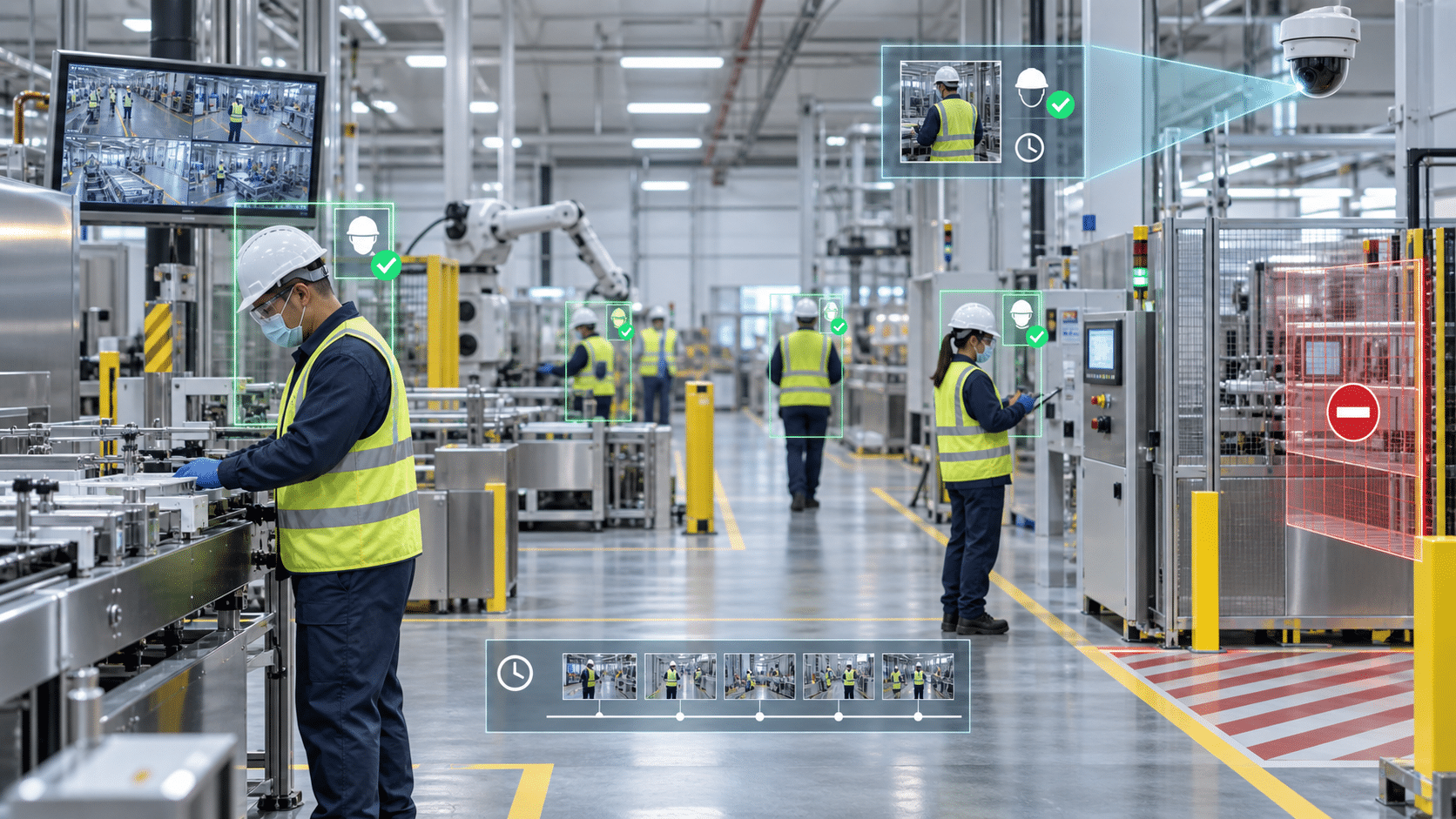
Most plants reach a boundary where controller data stops answering the question. A programmable logic controller knows that a cycle completed and a fixture closed, but it does not know whether the correct bracket went into the assembly, whether a label matched the work order, whether a pallet of held material was staged in a release lane, or whether someone entered a hazard zone while the equipment was moving. Those are visual facts, and until recently the only instrument available for capturing them was a person walking the floor with a clipboard.
This is the layer where Matroid operates. Matroid is an enterprise no-code computer vision platform for creating, deploying, and managing visual AI detectors across inspection, manufacturing, security, compliance, and operational monitoring use cases, which means the same architecture that inspects a part can also monitor a process condition or an area state. Matroid says users can detect and classify defects, objects, assemblies, hazards, and events, and that range is what allows a single visual layer to serve quality, safety, and compliance stakeholders instead of forcing three separate deployments.
Two platform characteristics matter most when the goal is continuous monitoring rather than a one-off study. Matroid says its software works with any image or video hardware, so a plant can build on the cameras and video infrastructure it already owns and add coverage incrementally instead of committing to a hardware refresh before the first result. Matroid also says its platform includes a custom detector studio, MLOps architecture, quick training, and analytics from video streams, which addresses the practical reality that compliance requirements change as products, standards, and lines change. A detector that cannot be retrained by the people who understand the process will fall out of date faster than the procedure it was built to verify.
Two cautions belong in any honest deployment plan. No-code does not mean no oversight, and a serious program still needs technical ownership for camera placement and lighting, validation against known conditions, monitored performance over time, change control when detectors are updated, and clear governance for anything involving people rather than parts. Detection accuracy also depends on the specific condition, environment, and configuration, so results should be established through a scoped proof of concept on your own lines and your own failure modes rather than assumed. Visual AI is an instrument that extends what a plant can observe continuously, and the judgment about safety, product release, and regulatory obligation stays exactly where it belongs.
If your current compliance stack can tell you what the procedure required but not what the station actually did, that is the gap worth closing first, and it is the gap continuous visual monitoring was built for. Get a demo to see how Matroid detectors would apply to the specific checks, stations, and deviations that consume your team’s time today.
TL;DR: A compliance program is only as strong as the last hour of production it can honestly account for. Documentation proves that a plant knew what it was supposed to do, while continuous monitoring is what shows the work was actually done that way, on that shift, at that station, with the materials and settings the procedure called for.
Building Custom Computer Vision Models with Matroid
Dive into the world of personalized computer vision models with Matroid's comprehensive guide – click to download today