
How to Document Quality Control Procedures for Manufacturing Audits Using Vision Data
Jeff Zeller | September 15th, 2026
An auditor rarely opens by asking whether a plant can build a good part. The first real question is usually closer to how a specific inspection is performed, who approved that method, and where the records of the last production run are stored. A manufacturing process audit, as Tervene describes it, is a systematic examination of the production process that inspects and verifies that work is done according to the proper standards and procedures, which puts the written procedures on trial alongside the product itself. Quality teams that struggle in audits often struggle on documentation rather than capability, because daily practice on the floor slowly drifted away from the language sitting in the controlled document.
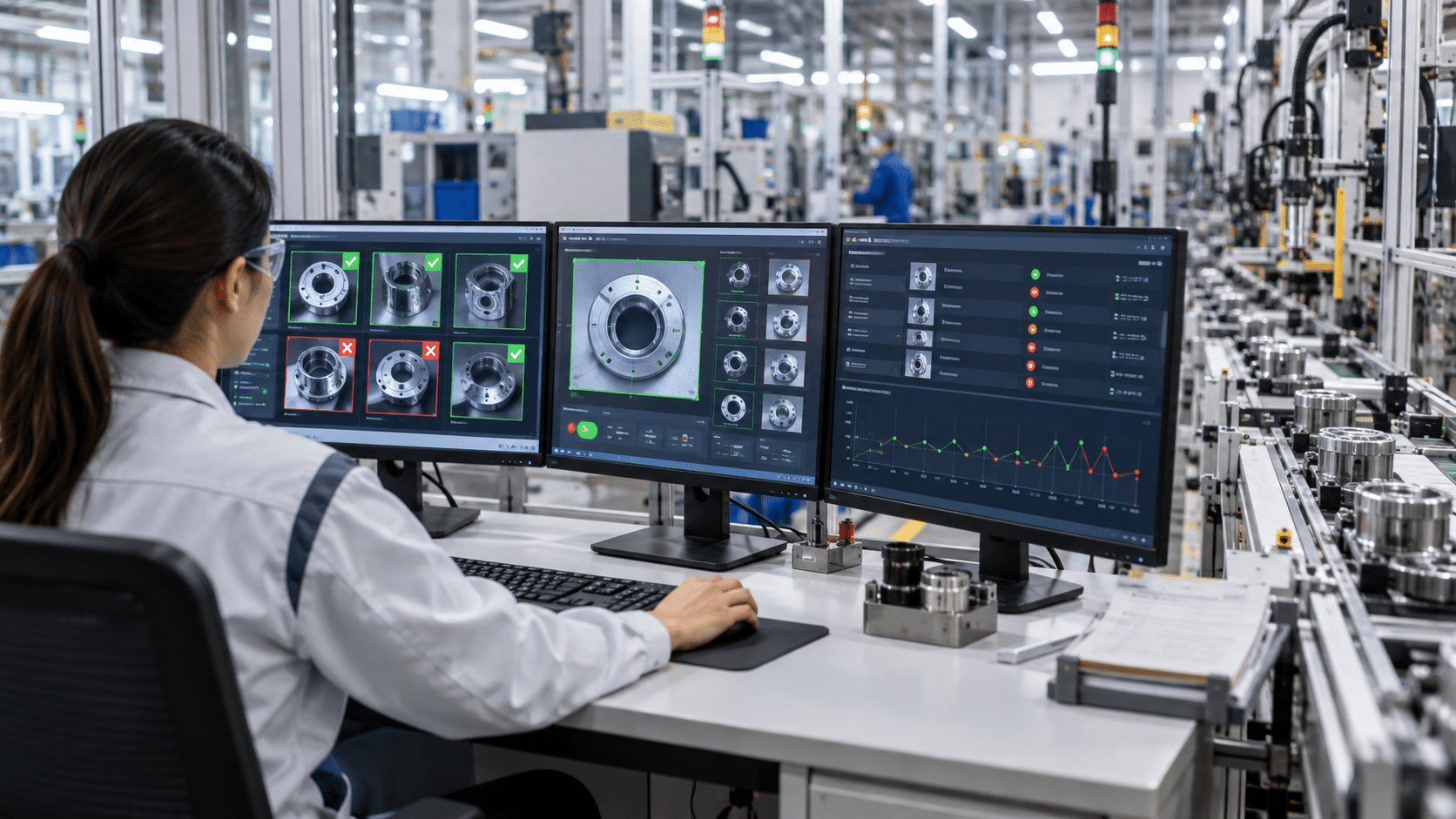
Vision data changes what that documentation is able to contain because automated inspection produces timestamped images, detector outputs, and event histories that describe what actually happened at a station instead of what someone recalled at the end of a shift. Matroid’s no-code computer vision platform works with any image or video hardware, users can detect and classify defects, objects, assemblies, hazards, and events, and the platform includes a custom detector studio, MLOps architecture, quick training, and analytics from video streams. None of that evidence carries weight in an audit unless it lives inside a controlled system with named owners, revision history, and retention rules attached to every artifact.
What Audit-Ready Documentation Actually Requires
Audit-ready documentation is not the same thing as thorough documentation, and it is not the same thing as recent documentation. What an auditor tests is whether the written method, the approval behind that method, and the record of its execution all agree with one another for the same part, on the same line, on the same date. Document control is the mechanism that produces that agreement, and QIA states the point directly: This traceability serves as proof during inspections and audits that processes are consistently managed and executed according to approved standards. Precision and consistency are the operating currency of manufacturing, and controlled documents are what stop that consistency from eroding quietly between shifts, sites, and revisions.
In practice, an audit-ready system lets you produce four things on request without improvisation. You need the current approved revision of the procedure, a record showing the procedure was executed as written, evidence that a qualified person reviewed and released both the method and the result, and a trail of past findings with corrective actions assigned to clear owners and deadlines, which Tervene identifies as a core part of a concise audit reporting system. If any one of those four is missing, the other three tend to look weaker than they are.
Phase 1: Map the Document Set Before Drafting Begins
Most documentation projects fail because drafting starts before anyone agrees on the boundaries of the document set. Before writing a single work instruction, inventory every artifact that an auditor could reasonably request when examining one product family through one production line, and record who owns each artifact today. The map matters more than the prose at this stage, because it reveals procedures that exist only as tribal knowledge and records that exist only in an operator’s notebook.
- The quality manual and the top-level procedure that governs document control itself
- Process-level control plans and inspection plans tied to specific part numbers
- Station work instructions, including setup, changeover, and line clearance steps
- Inspection and test records, including automated visual inspection outputs
- Detector configuration and release records for any vision system in the control plan
- Nonconformance, corrective action, training, and calibration records
Assign a single accountable owner to each row of that inventory, and write down where the master copy lives and how long the associated records are retained. Publishing the map to production, quality, and maintenance leaders before drafting keeps the effort transparent and, as Tervene notes about audits generally, helps ensure there are no surprises later in the report. Gaps found during mapping are cheap to fix, while gaps found during an audit are expensive and public.
Phase 2: Build Version Control and Approval Workflows
Version control is the part of the system that turns a pile of accurate documents into defensible evidence. Every controlled document needs a unique identifier, a revision number, an effective date, a documented reason for the change, and a named approver whose role authorizes that approval, so that any record can be matched to the exact revision in force when the work was performed. Approval workflows should be written as sequences rather than habits, specifying who drafts, who reviews technically, who approves for release, and who confirms that the release reached every station and terminal that needs it.
The workflow also has to handle withdrawal, because obsolete revisions cause more audit findings than missing revisions do. Define how superseded documents are removed from circulation, how any retained historical copy is marked, and how long that history is kept for traceability. Treat vision system configurations as controlled items in the same register: the detector in use, its version, its thresholds, and the approval that released it into production all belong under change control. When an audit report is compiled, TradeAider notes that it should carry detailed findings alongside corrective actions, and version history is what lets you show whether a past corrective action was actually implemented in the document that governs the work.
Phase 3: Capture and Attach Vision Data as Controlled Evidence
Vision systems generate far more data than an audit needs, so the documentation task is deciding which outputs constitute quality records and writing that decision down. Start from the control plan and identify each inspection characteristic that a detector is responsible for verifying, then define the record that inspection produces, the retention period for that record, and the place where it is filed. A stream of images with no defined relationship to a part number, a shift, and an approved procedure is data rather than evidence, and auditors will treat it that way.
For each automated inspection record, capture the fields that let someone reconstruct the decision months later without interviewing the operator who was present.
- Part number, work order or batch identifier, line, station, and shift
- Timestamp and camera or stream identifier
- Detector name, version, and configured thresholds at the time of inspection
- Classification result, including the defect or event class returned
- Disposition of the part and the person or rule that authorized it
- Link to the controlled procedure revision governing the inspection
Because Matroid works with any image or video hardware, existing plant cameras can often feed these records without a separate imaging program, and analytics from video streams can summarize detection trends across a run rather than a single frame. Write the human step into the procedure explicitly, since automated inspection supports quality judgment rather than replacing the trained reviewer who dispositions borderline results and confirms that a detector is behaving as released. Documentation should also state where cameras are pointed and why, keeping the scope on process and product rather than individual worker monitoring, and defining who may access stored footage. That scoping statement is a governance record in its own right, and having it approved in advance is easier than explaining its absence during an audit.
Phase 4: Close the Loop Between CAPA Records and Controlled Procedures
A corrective and preventive action record is only complete when it changes something that governs future work. The chain should read cleanly from the detected condition to the nonconformance record, from that record to the investigation and root cause, from root cause to the corrective action, and from the corrective action to the specific document revision that implements the fix. Vision data strengthens the first and last links in that chain, because the same detector evidence that surfaced a defect pattern can later show whether the pattern disappeared after the revised procedure took effect.
Build effectiveness verification into the CAPA form rather than leaving it to memory, naming the evidence that will be reviewed, the window over which it will be reviewed, and the owner who signs the closure. Deltek describes the audit report as the deliverable that carries results outward, noting that This report is a crucial deliverable that communicates the results of the audit to the auditee and stakeholders. Findings compiled into a structured report only become improvement when each one is assigned to a clear owner with a deadline and traced into a released revision. When an auditor samples a closed CAPA and finds the procedure, the training record, and the inspection evidence all updated in step, the sample usually ends there.
The Shop-Floor Copy Problem and How to Prevent a Major Nonconformance
The most common documentation failure in manufacturing is also the most physical one, and it lives in laminated sheets taped beside a machine. Someone printed a work instruction during a difficult launch, the instruction was helpful, and it stayed at the station through three subsequent revisions that never reached the tape. An auditor who finds operators working from an uncontrolled copy has evidence that the document control system does not govern actual production, which is exactly the kind of systemic gap that escalates from an observation to a major nonconformance.
Prevention is procedural rather than technological, so give every station a single retrieval path to the current revision, whether that is a terminal, a tablet, or a controlled printed copy logged in a register with an expiry and a named custodian. Add a revision check to line clearance and changeover steps so that verifying the document is part of starting the job rather than a separate audit-preparation task. Then sweep the floor periodically for undocumented paper and treat every copy found as a finding with an owner and a deadline. Inspection evidence helps here as well, because records showing what was actually checked at a station make it visible when practice and the current revision have quietly diverged.
When the Audit Uncovers a Document Control Failure Mid-Audit
Sooner or later an auditor will pull a document that does not match the record beside it, and the next twenty minutes determine how large the finding becomes. Acknowledge the discrepancy plainly instead of arguing interpretation, because auditors analyze what they observe and prepare a detailed report regardless of the conversation in the moment. Then move immediately to scope, since the difference between one station using an outdated instruction and an entire product family doing so is the difference between a contained finding and a systemic one.
Scope the breach with evidence rather than assurance by identifying which revision was in force, which parts were produced under the incorrect method, and whether inspection records show any resulting defect escapes, and state the containment action you are taking on affected inventory before the audit closes. Assign the corrective action to a named owner with a deadline during the closing meeting rather than after the report arrives. Deltek frames the audit report as a critical tool for understanding the state of a quality management system and making informed decisions about improvements, and a finding you have already scoped and contained enters that report as a managed issue instead of an open question.
Continuous Improvement Outputs That Must Re-Enter Document Control
Improvement activity generates changes faster than most document systems absorb them, and that lag is where audit exposure accumulates. Kaizen adjustments to station sequence, revised sampling frequencies, new defect classes discovered during a difficult run, updated thresholds, and retrained detectors are all changes to the way quality is verified, which means each one belongs in a controlled revision rather than in a project summary. Vision programs are particularly prone to this drift, because MLOps architecture and quick training make detector iteration fast enough that the technical change can outrun the paperwork by weeks.
Set a fixed cadence for folding improvement outputs back into the document set, and route every detector release through the same approval workflow that governs written procedures. Whoever approves a threshold change should confirm that the control plan, the work instruction, the record format, and the operator training all reflect the new method before it goes live. Audit reports compiled from structured findings then become a genuine improvement input rather than a recurring list of the same document control gaps, and the improvement history itself becomes traceable evidence that the system is being managed.
The Done State for Audit-Ready Quality Control Documentation
You can consider this work finished when four conditions hold at any moment, without preparation. Any procedure an auditor names can be retrieved at its current revision within a few minutes, with its approval and change history intact. Any inspection record, including automated visual inspection output, can be traced to the part, the station, the detector version, and the procedure revision that governed it. Every closed corrective action points to a released document change and to the evidence used to verify effectiveness. Every station on the floor works from the controlled source with no uncontrolled copies in circulation.
That state is what turns an audit from a performance into a walkthrough of a system already operating as described, and it is the practical meaning of the traceability that document control provides. Vision data makes the evidence layer far richer than manual inspection sheets allow, provided the images, classifications, and event histories are treated as controlled records with owners and retention rules. If you are building that evidence layer and want to see how no-code detectors fit inside your existing cameras and quality documentation, get a demo and walk through your own inspection points with the Matroid team.
TL;DR: Manufacturing audit failures often trace back to documentation gaps rather than process failures, and vision data closes that gap by capturing timestamped inspection images, detector outputs, and event histories that prove what actually happened at each station rather than relying on end-of-shift recall.
Building Custom Computer Vision Models with Matroid
Dive into the world of personalized computer vision models with Matroid's comprehensive guide – click to download today