Who We Are
At Matroid, we aim to accelerate AI, responsibly, through vision. AI is an ambitious, unsolved problem, so we're building a world class team with innovation and engineering excellence embedded into our culture.


Evolution of AI and Matroid
2012 - 2016
CNNs (Convolutional Neural Networks)
AlexNet’s 2012 ImageNet win ignited the deep learning era for computer vision.
VGGNet, GoogLeNet, and ResNet followed, dramatically improving image classification and object detection accuracy over traditional hand-crafted features.

Where Matroid Began
Matroid saw growing demand to automate basic tasks with computer vision, reducing operating costs, increasing efficiency, safety and regulatory compliance, bridging the gap between cutting edge computer vision research and industry deployment.
2016 - 2020
Stronger CNNs, early self-supervision
YOLO and Mask R-CNN made real-time detection and segmentation practical for industry.
EfficientNet optimized CNN scaling, while early self-supervised methods began showing models could learn visual features without labeled data.
Matroid Gains Traction
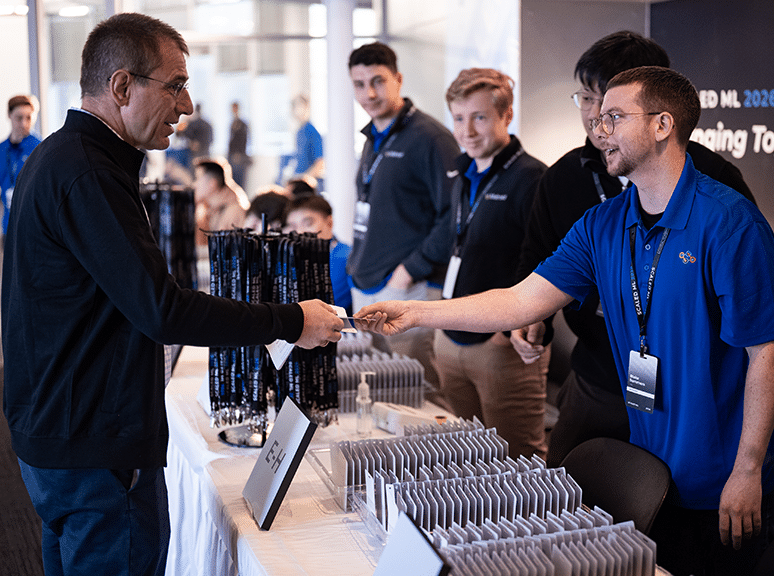
As our facilities and product capabilities expanded, our product, sales, engineering, and marketing teams grew with them, allowing us to reach more customers and deliver solutions that meet their needs.
2020 - 2023
Transformers, early VLMs
Vision Transformers (ViT) proved attention-based architectures could rival CNNs on image tasks.
CLIP and ALIGN paired vision with language at scale, enabling zero-shot recognition and laying the groundwork for multimodal AI.

Matroid at Enterprise Scale
Matroid is deployed across the globe, helping governments and companies deploy computer vision in their environments to detect objects, defects, safety compliance, and so much more.
2023 - 2026
Vision Foundation Models
Large pre-trained models like DINOv2 and SAM generalize across tasks with minimal fine-tuning.
Multimodal LLMs unify vision and language, enabling open-ended visual reasoning and agentic image understanding.
Pushing Into the Future
Matroid pushes the boundaries of computer vision, creating the next generation of AI software that lowers the barrier to entry and makes it more accessible for those working to build a safer and more productive world.
Evolution of AI and Matroid
2012 - 2016
CNNs (Convolutional Neural Networks)
AlexNet’s 2012 ImageNet win ignited the deep learning era for computer vision.
VGGNet, GoogLeNet, and ResNet followed, dramatically improving image classification and object detection accuracy over traditional hand-crafted features.
Where Matroid Began
Matroid saw growing demand to automate basic tasks with computer vision, reducing operating costs, increasing efficiency, safety and regulatory compliance, bridging the gap between cutting edge computer vision research and industry deployment.
2016 - 2020
Stronger CNNs, early self-supervision
YOLO and Mask R-CNN made real-time detection and segmentation practical for industry.
EfficientNet optimized CNN scaling, while early self-supervised methods began showing models could learn visual features without labeled data.
Matroid Gains Traction
As our facilities and product capabilities expanded, our product, sales, engineering, and marketing teams grew with them, allowing us to reach more customers and deliver solutions that meet their needs.
2020 - 2023
Transformers, early VLMs
Vision Transformers (ViT) proved attention-based architectures could rival CNNs on image tasks.
CLIP and ALIGN paired vision with language at scale, enabling zero-shot recognition and laying the groundwork for multimodal AI.
Matroid at Enterprise Scale
Matroid is deployed across the globe, helping governments and companies deploy computer vision in their environments to detect objects, defects, safety compliance, and so much more.
2023 - 2026
Vision Foundation Models
Large pre-trained models like DINOv2 and SAM generalize across tasks with minimal fine-tuning.
Multimodal LLMs unify vision and language, enabling open-ended visual reasoning and agentic image understanding.
Pushing Into the Future
Matroid pushes the boundaries of computer vision, creating the next generation of AI software that lowers the barrier to entry and makes it more accessible for those working to build a safer and more productive world.

Founder & CEO
Reza Zadeh
Reza is CEO of Matroid and an adjunct professor at Stanford, conducting research and teaching doctoral courses. Previously, he was on the founding team at Databricks and worked on Language Models for Machine Translation at Google.
Board and Advisors

John Tough
John is a Managing Partner at Energize Ventures, where he has been leading investments into software companies in the industrials and energy verticals since 2017.

Matei Zaharia
Matei is a co-founder and Chief Technologist at Databricks, as well as an Assistant Professor at Stanford University. He is the creator of Apache Spark, MLflow, and many other successful projects.

Ion Stoica
Ion is Executive Chairman at Databricks, CTO at Conviva, and Professor of Computer Science at UC Berkeley, where he works on cloud computing, distributed systems, and networking.

Pete Sonsini
Pete is a General Partner at NEA, who joined in 2005 focusing on early-stage enterprise software, services, and systems companies. He is the co-head of NEA’s enterprise software practice group.

Chris Hadfield
Colonel Chris Hadfield is an astronaut, former ISS commander, business leader, entrepreneur, best-selling author, and global speaker on leadership, change, and managing life.
Investors