
Terra Carta 2026: AI in Practice

Jeff Zeller | March 23rd, 2026

Matroid Attends Terra Carta 2026 Alongside Global Leaders
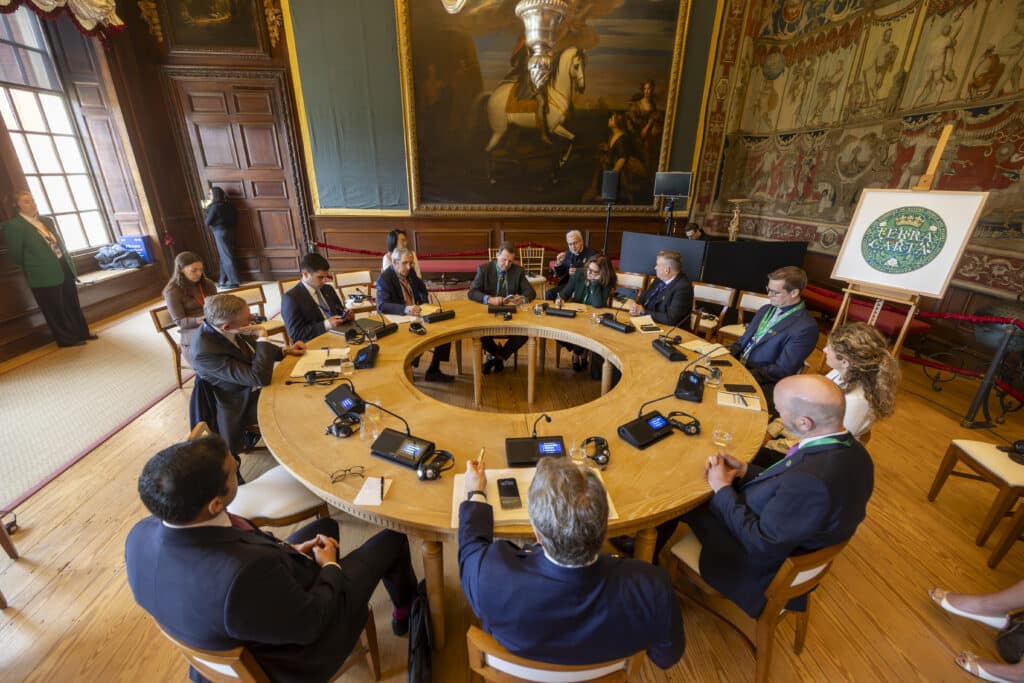
The Terra Carta 2026 Spring Summit, convened under the Sustainable Markets Initiative, brought together a global coalition of leaders focused on one central objective: accelerating the transition to a sustainable, resilient global economy.
Held at Hampton Court Palace, the summit gathered heads of state, CEOs, chairpersons, and institutional leaders across sectors that define the modern world. Finance, infrastructure, energy, aerospace, and advanced technology were all represented, reflecting the breadth of industries required to drive meaningful change.
The Sustainable Markets Initiative, founded by His Majesty King Charles III, was created to bridge the gap between ambition and implementation. Terra Carta serves as a framework for aligning private sector innovation with global sustainability goals, with a focus on practical action rather than policy alone.

This year’s program reflected that intent. Sessions and roundtables focused on how organizations are deploying technology to address real challenges across supply chains, infrastructure, and industrial systems. Leaders from major institutions, including global banks, infrastructure firms, and industrial technology companies, participated in discussions centered on execution, investment, and scale.
The presence of His Majesty King Charles III underscored the initiative’s importance. His engagement with attendees during the roundtables and exhibition highlighted the role of collaboration between the public and private sectors in advancing sustainability efforts.
Across these discussions, a consistent theme emerged. Artificial intelligence is no longer a future concept or a parallel initiative. It is already embedded in how critical systems operate.
The tone of the summit reflected a shift in mindset. Conversations shifted from exploring potential to examining where AI is already delivering measurable outcomes. In manufacturing, energy, and infrastructure, organizations are using AI to continuously monitor operations, improve efficiency, and reduce environmental impact.
This shift was especially evident in conversations around industrial systems. Leaders described how AI is being integrated into production environments to provide real-time visibility, enabling faster decision-making and more efficient resource use.
Matroid’s participation in Terra Carta builds on years of deploying computer vision systems into these environments. The platform analyzes images and video in real time, allowing organizations to understand what is happening across their operations without relying on manual inspection.
This capability has immediate applications across industries. From a manufacturing perspective, it improves quality control by identifying defects as they occur. Infrastructure-wise, it enables continuous monitoring of assets and construction processes. In energy and heavy industry, it supports safer operations and more efficient resource utilization.
These outcomes directly support sustainability objectives. When organizations can detect inefficiencies early, they reduce waste, lower energy consumption, and improve overall system performance. Real-time visibility also improves safety by identifying risks as they emerge, allowing for immediate response.

Matroid’s involvement in Terra Carta is part of its broader engagement with global sustainability efforts through the Sustainable Markets Initiative and Astra Carta. These initiatives bring together organizations that are applying advanced technologies to address environmental and industrial challenges at scale. Through this work, Matroid contributes to efforts that span manufacturing, aerospace, and infrastructure, where AI-driven insights can improve both operational efficiency and environmental outcomes
The conversations at Terra Carta reflected a broader shift across industries. AI is no longer being evaluated as an experimental capability. It is being treated as a core component of modern operations.
Organizations are moving from pilot projects to production systems. The focus is on deploying solutions that integrate into existing workflows, operate continuously, and deliver consistent results.
This shift requires a different approach to technology adoption. Systems must be accessible, scalable, and capable of working within real-world environments. They must also provide immediate value, allowing organizations to justify investment through measurable improvements.
Matroid’s platform aligns with these requirements by enabling domain experts to build and deploy computer vision systems without specialized machine learning expertise. This reduces the time between identifying a problem and implementing a solution, allowing organizations to scale AI across their operations more effectively
As Terra Carta 2026 made clear, the conversation around AI has entered a new phase. The question is no longer whether AI will be used in critical industries. It is already in place.
The focus now is on how quickly it can be deployed more broadly, how effectively it can be integrated, and how much impact it can deliver at scale.
For organizations participating in the summit, that work is already underway.
Building Custom Computer Vision Models with Matroid
Dive into the world of personalized computer vision models with Matroid's comprehensive guide – click to download today