
Visual Inspection Machines and When Fixed Hardware Still Beats Flexible Vision Systems
Jeff Zeller | September 10th, 2026
A defect that escapes the line costs far more than the same defect caught at the station where it was created, and every inspection decision a plant makes is really a decision about where that catch happens. That is why the question of what to inspect with rarely arrives as a clean technology evaluation, since it usually arrives as a budget line, an existing machine that mostly works, and a quality manager who has to justify either keeping it or replacing it.
The available options run from a bench where an operator holds a container against a light panel, to a purpose-built machine that rotates units past fixed cameras on a validated recipe, to a learned detector running against video feeds that are already installed. Each tier solves a different problem, and the newest tier does not automatically dominate the oldest one. Fixed inspection hardware still wins on plenty of lines, and knowing which lines those are saves both capital and a great deal of revalidation work.
Equipment Tiers and Where Manual Inspection Runs Out of Room
Inspection equipment sorts into tiers, and equipment vendors organize their catalogs the same way for a reason. Stevanato Group divides its pharmaceutical inspection offering into manual equipment intended to carry a product smoothly from laboratory work into mass production, semi-automatic machines that ease the operator’s daily activities while keeping the inspection accurate, and automatic equipment built for products held in syringes, ampoules, vials, cartridges, and bottles. The group frames that range against more than thirty years of inspection experience, which matters because the tiers are not generations that replace one another. They coexist inside the same building, often on adjacent lines, because product volume and risk profile differ from one program to the next.
What changes between tiers is who makes the accept or reject call and how consistently that call gets made. Antares Vision Group describes automated inspection as a system that performs the individual accept or reject decision automatically according to validated inspection parameters, which takes operator judgment out of the loop at the moment of decision. Manual inspection keeps that judgment in place, and the judgment is the part that degrades over a shift. The AI Vision Inspection for Equipment Maintenance Guide reports that Human visual inspection accuracy degrades 20% after just 2 hours of repetitive evaluation and varies 30% between inspectors reviewing the same defect. The same guide describes a review cycle in which processing every inspection photo, classifying crack severity, and writing work orders for the fourteen defects found consumed six days, alongside a fatigue-driven misjudgment on a hairline weld crack that propagated into a through-wall failure eleven months later at a cost of $740,000 in emergency repair and lost production.
Manual inspection therefore runs out of room not at a particular defect type but at a duty cycle, because once inspection volume exceeds what an alert person can sustain, the resulting numbers stop describing product quality and start describing operator fatigue.
Validation Costs When Regulated Lines Swap Inspection Logic
On a regulated line the inspection method is not simply a tool choice, since the method itself forms part of the qualified process. The Guide to Vision Inspection Systems for Pharmaceuticals lays out the layers that govern this work, including 21 CFR Part 211, FDA guidance on the inspection of injectable products for visible particulates, USP 1790, and USP 790. Taken together, those layers establish a framework requiring 100 percent inspection plus AQL testing that continuously verifies the inspection process is actually effective. That structure carries an important consequence for anyone weighing new hardware, because the burden of proof does not sit on the defect but on the process that is supposed to catch it.
Fixed inspection machines carry a quiet advantage inside that framework, since their decision logic is frozen and already documented. Antares Vision Group describes machines configured according to container geometry, product characteristics, fill volume, production speed, and defect profile, running a cycle in which rotation stops according to the inspection recipe before images are acquired. A recipe built that way is deterministic and legible, and once it has been qualified against a defect library it behaves the same way in month eighteen as it did during qualification. Swapping the logic underneath means the existing qualification evidence now describes a system that no longer exists, which is why replacing a functioning inspection method is rarely a same-quarter project.
Costs compound from there, because requalification consumes engineering time, defect kit preparation, documented runs, and review cycles that compete directly with production schedules. None of that effort appears on the quotation for the machine itself, which the same guide places between one million and four million dollars for high-speed automated inspection equipment. Teams that budget only for capital and installation tend to discover the validation line item well after the purchase order has been signed, and that discovery is what turns a twelve-month plan into a two-year one.
Accuracy Drift and the Unknown Defect Gap in AI Vision Systems
Published results for learned inspection systems are genuinely strong, and they are also specific to the deployments that produced them. Automated Visual Inspection for Manufacturing: A Practical Guide for Quality Teams cites a case study reporting more than 1,200 annual inspection hours saved, coverage of 46 product variants, a 5 percent yield improvement, and 99.99 percent detection accuracy. The Guide to Vision Inspection Systems for Pharmaceuticals cites a separate case in which automated vial inspection reached 98 percent detection accuracy. Both figures describe one product family, one optical setup, and one defect library, and neither figure transfers to a different line merely because the underlying software is the same.
Detection performance is a property of the whole system rather than of the model alone, which is why accuracy is better treated as something to monitor than as something to purchase. Ambient lighting shifts across a day, camera mounts move slightly after maintenance, a container supplier changes and the glass reflects differently, and a detector calibrated against the old conditions begins returning results that no longer match what an experienced inspector sees. None of that constitutes a fault in the software, but all of it moves the numbers, and a line without monitoring in place will not notice the movement until a customer complaint or an AQL failure surfaces it.
The harder limitation is the defect that nobody has characterized yet, and it constrains both architectures equally. A learned detector recognizes the classes represented in its training data, so a genuinely novel failure mode can pass through a system that is performing exactly as designed. Fixed inspection hardware has the same blind spot wearing different clothes, because a recipe measures only what it was configured to measure and a flaw outside the inspected zone stays invisible to both approaches. Neither architecture removes the need for human review of escapes and complaints, and treating either one as the final word on product safety is the mistake that turns a capable inspection program into a fragile one.
Retrofitting Vision Software Onto Existing Inspection Hardware
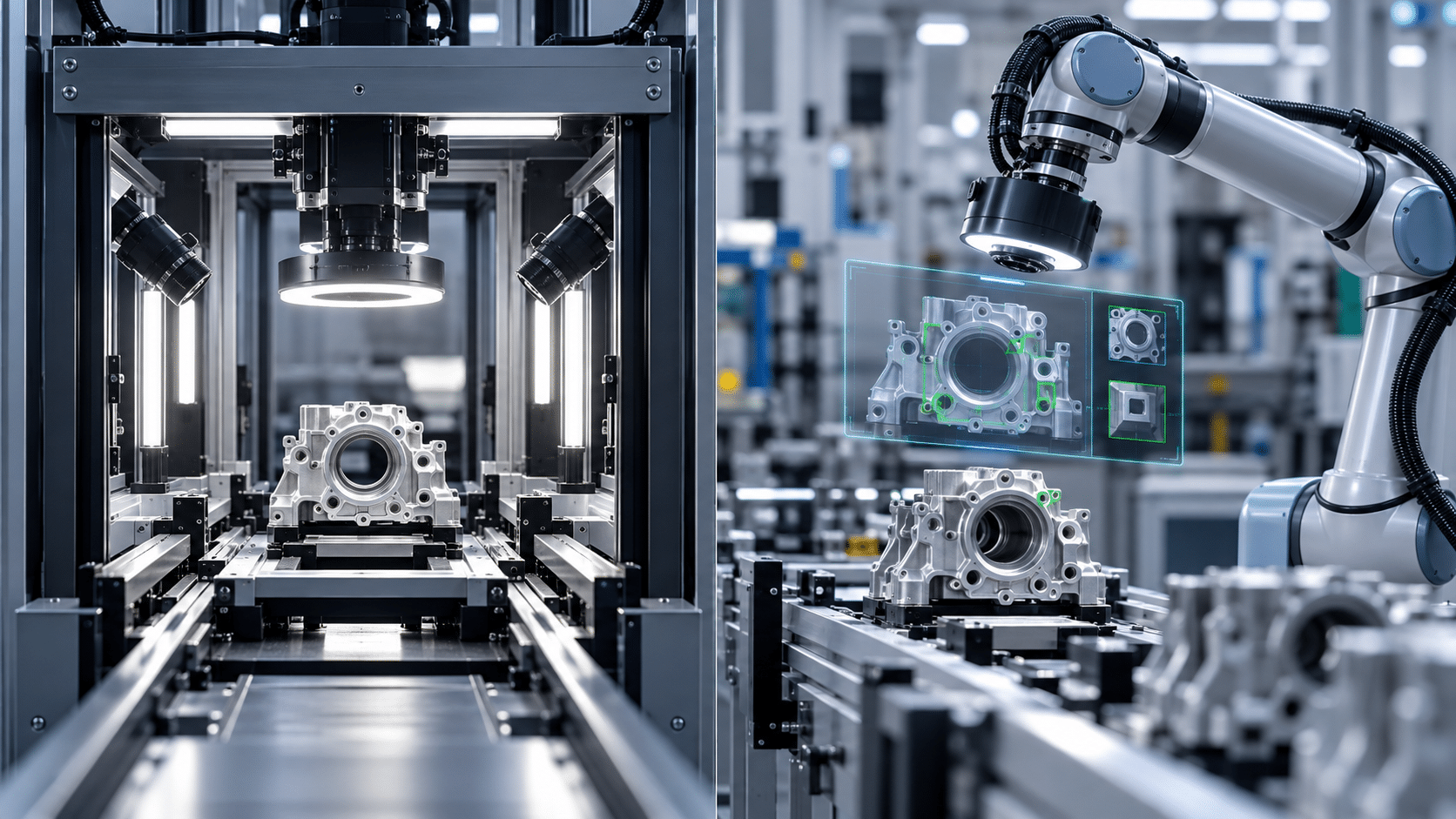
There is a middle path between leaving a fixed machine untouched and replacing it outright, and it usually costs far less than either option. Most of what a purpose-built inspection machine provides is mechanical, including handling that presents the container consistently, lighting that makes the defect visible, triggers that fire at the right moment in the cycle, and a reject mechanism that removes the unit from the flow. That mechanical stack is the expensive part, it is already qualified, and it does not become obsolete when the decision logic improves. Retrofitting means keeping the handling and replacing or supplementing only the layer that interprets the image.
Camera-agnostic software changes the arithmetic of that middle path in a specific and practical way. Matroid works with any image or video hardware, so the cameras, optics, and frame rates already sitting on the line can feed a new detector rather than being torn out alongside the old logic. Users can detect and classify defects, objects, assemblies, hazards, and events, which means a single deployment can cover product quality and the operational conditions surrounding it. The platform includes a custom detector studio, MLOps architecture, quick training, and analytics from video streams, and that combination is what keeps a retrofit from becoming an experiment with no path to sustained operation.
Retrofits are also how inspection reaches processes that never justified a dedicated machine in the first place. Automated steel slab defect detection, aluminum extrusion quality control, and comparable heavy industry applications involve surfaces that are too large, too hot, or too variable for the container-handling architecture that pharmaceutical machines are built around. In those environments a camera is frequently installed already for operator monitoring, and the missing piece is the interpretation layer rather than the optics or the fixturing.
No-code does not mean no technical oversight, and a retrofit still requires people who understand the process being watched. Someone has to define what counts as a defect, assemble representative images including the awkward edge cases, decide how detector output connects to the reject mechanism or the operator screen, and monitor performance once the line is running at rate. On a regulated line the retrofit also inherits the validation burden described above, because changing how the accept or reject decision gets made changes the qualified process regardless of how simple the change was to implement.
Return on Investment Across Fixed and Flexible Inspection Setups
The case for any inspection investment starts with what poor quality already costs rather than with what the equipment costs. RoboticsTomorrow cites the American Society for Quality estimate that the cost of poor quality can affect a manufacturing company’s bottom line by as much as 15 to 20 percent of total sales revenue, which establishes the size of the pool that inspection exists to protect. The same source places the return on automatic visual inspection investment at twelve to eighteen months through reduced scrap, lower labor costs, and the elimination of expensive recalls.
Payback estimates vary according to what the inspection is actually protecting the business against. The AI Vision Inspection for Equipment Maintenance Guide places most deployments at seven to twelve months of payback from avoided failures alone, and it attributes the value to three sources: defects caught earlier cost less to fix, 100 percent coverage eliminates sampling risk, and objective severity classification removes subjectivity from repair timing decisions. That guide also describes the shift from quarterly to continuous inspection frequency along with four to eight weeks of failure prediction lead time, which is the kind of change that reshapes maintenance planning rather than only inspection headcount.
Against those returns sits the capital line, and the Guide to Vision Inspection Systems for Pharmaceuticals states that High-speed AVIs typically cost between $1 million and $4 million and require ongoing maintenance plans, where the maintenance clause deserves as much scrutiny as the purchase price. The upside can still be dramatic, and the same guide describes a manufacturer holding roughly ten million prefilled syringes in quarantine who recovered about $3.2 million through automated inspection of that stock. A result like that reframes the question entirely, because the machine did not pay for itself through daily throughput but through a single release decision on inventory that had otherwise been written off.
Plants pursuing computer vision for zero-defect manufacturing rarely arrive there through one purchase, and flexible software layered onto working hardware changes the shape of the calculation rather than only its size. A smaller upfront commitment lets a team prove value on one process and gather real numbers before deciding whether the next line genuinely deserves dedicated equipment.
Matching Fixed Hardware or Flexible Vision to the Production Line
The decision is seldom fixed hardware or flexible vision in the abstract, because it depends on how stable the product, the container, and the defect library actually are over the life of the program. Three variables settle most of these calls: how much the product changes from run to run, how tightly the process is regulated, and whether the existing hardware already presents the part well enough to inspect properly.
- Fixed hardware still wins when one container format runs at high speed, the defect library is stable, and the recipe is already qualified against it.
- Fixed hardware wins again when mechanical handling is inseparable from the inspection itself, since presentation and rejection are the hardest parts to retrofit.
- Flexible vision wins when product variants multiply faster than recipes can be written and qualified one at a time.
- Flexible vision wins when the surface is large, irregular, or hostile, and no container-based machine fits the geometry of the process.
- A retrofit fits when optics and handling are adequate but the interpretation layer misses defects the team can clearly see in the captured images.
Even a well matched machine needs tuning against real defects rather than theoretical ones. Eyetec’s troubleshooting practice uses engineering runs to optimize parameters and, when needed, particle-seeded test samples that mimic challenging defect scenarios, an approach the firm applied to automated inspection systems for viscous syringe products in eastern Europe, which it describes as a notoriously difficult application. The lesson travels well beyond pharmaceuticals, because an inspection system is only as trustworthy as the defect samples used to prove it, and a plant that cannot produce representative defects cannot honestly evaluate either architecture.
Fixed hardware still beats flexible vision on plenty of lines, and the honest version of that decision usually ends with a scoped trial on a single process instead of a capital request written against a brochure. Teams weighing no-code computer vision use cases for production lines against another round of dedicated equipment can get a demo and watch a detector run against their own footage before anything on the line changes.
TL;DR: Plants choosing an inspection method should treat manual stations, purpose-built fixed-camera machines, and AI-based vision systems as distinct tools rather than a straight upgrade path, since fixed hardware remains the better choice on lines with stable products and validated recipes, while learned vision suits variable products already covered by installed cameras, saving unnecessary capital spend and revalidation effort.
Building Custom Computer Vision Models with Matroid
Dive into the world of personalized computer vision models with Matroid's comprehensive guide – click to download today